




The quick response to this question is No. If you ignore the check engine light and drive to a fog testing station, you will fail the fog test. Additionally, many states in the US won't even let you take the fog test with a car's check engine light on.
When a car is due for a fog test, you might be wondering if having the check engine light might jeopardize the fog test results.
Numerous variables can affect the results of the fog test. Many drivers are always not aware of the core reason for these failed tests with the check engine light on.
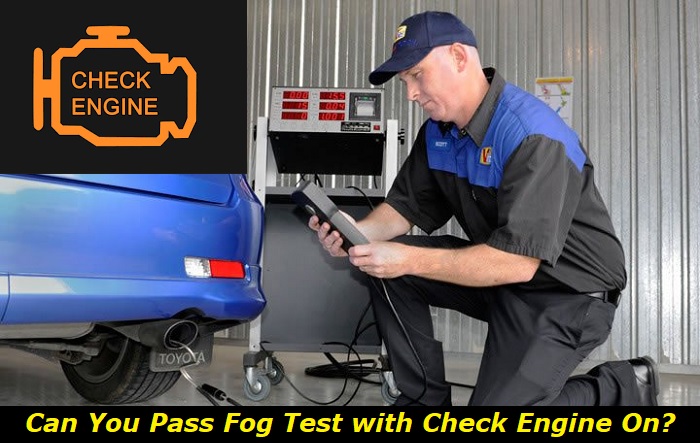
The mechanism behind passing a fog test does not require some magic. To pass it, you must first ensure that the content of the exhaust fumes coming from the vehicle's tailpipe falls within your state's defined ''normal range'' of fog.
Having the check engine light on is a clear indicator of having some flaws with your car's emissions system.
To make up for flaws in a car's fog equipment, there are several techniques you might apply to help you modify the chemical composition of the fumes that come from the exhaust of a car and make it environmentally friendly to help you pass the fog test.
This is what is going to form the subject for discussion in this article so keep reading.
A Fog Test: What Is It?
When performing a fog test, the technician scans a vehicle's Vehicle Identification Number (VIN) and then connects a cable to the On-Board Diagnostic system often known as the OBD II. This enables the technician to perform the fog test in less than five minutes.
When this technique is compared to earlier fog tests, it provides a more accurate assessment of a vehicle's level of emissions and it is far less expensive. Usually, a fog test can be done in under five minutes.
The On-Board Diagnostic system is a feature that is present in all vehicles manufactured after 1996. Its main purpose is to identify and notify a car user of any emissions issues that a car may be experiencing before they become severe. This notification happens through a check engine light that comes on.
The OBD II through the check engine light will notify you of an emissions problem so that you can fix the car and stop excessive toxic exhaust fumes from being released into the air through your car's exhaust.
Additionally, it will also help the engine last longer and improve fuel economy therefore significantly lowering the cost of mechanic's bills.
Can I Pass Fog Test with My Check Engine Light On?
No. If you have a car manufactured in 1996 or thereafter, it probably has an OBD II feature and capability. In that case, having the check engine light on will directly affect passing the fog test.
For a majority of states in the US, the car won't even be tested with the check engine light on.
Although older cars may have the opportunity to pass the fog test, this only happens because they are not held to the same emissions standards as the most recent vehicles: those manufactured in 1996 or thereafter.
With a newer car, you won't be able to pass a fog test with the check engine light on because it may be a sign of car emissions system-related problems.
You won't pass this test because the check engine light could indicate a minor problem or a much more severe one associated with the emissions system.
What Emissions Problems are Likely to Trigger the Check Engine Light to Come On?
There are a lot of factors that may trigger the check engine light in a car. The computer installed in a car can cause the check engine light to come on, which occurs only when one or even more Diagnostic Trouble Codes (DTCs) are saved in a car's computer.
In this case, the check engine light will remain on as long as the problem is not fixed.
The reason why a vehicle won't pass the fog test with the check engine light on is that the light may illuminate if there is an issue that might or is already severely damaging the emissions control system of a vehicle.
You will need to find the source of the problem before it causes severe problems to the Engine Management System, car performance, or to the Emissions Control System especially if the warning light constantly stays on without showing any performance problems. This indicates a permanent problem that will not go away unless it is fixed.
When this occurs, it indicates that a critical part of the engine system has a major defect and it may not be safe to keep driving your car. The most common emissions-related problems that may trigger the check engine light include:
A faulty oxygen sensor
A loose gas cap
Malfunctioning spark plugs
A bad catalytic converter
Faulty airflow sensors
What Should You Do to Help Pass the Fog Test?
Most states in the US require passing some kind of emission or fog test every one or two years to be allowed to renew a car's registration.
Even though there have been programs for car fog tests for so many years, many car owners are still baffled as to why their cars fail these tests.
Here are some steps you can take to ensure a vehicle passes the fog tests.
Step 1: Doing All the Recommended Maintenance On Time to Keep Your Vehicle in Good Shape
For a vehicle to perform smoothly and efficiently, you must change the oil on schedule, replace bad air filters, repair or replace bad oxygen sensors, tighten a loose gas cap, replace worn spark plugs, repair or replace bad catalytic converters, replace faulty airflow sensors and also execute other necessary vehicle tune-ups.
Step 2: Visit a Reputable Car Repair Shop If the Check Engine Light Is On
The technicians will help to identify the issue and fix it. Your car may be emitting dangerous fog that is more than the EPA-allowed maximum limit because your emissions system is failing.
The failure of your emissions system will be shown by the check engine light coming on. If ignored, this may lead to more expensive-to-repair issues as well as increased damage to the catalytic converter.
NOTE: To pass the fog test your check engine light must be off. So if your check engine light is on, you must first take your vehicle to a technician to find the source of the problem, fix the problem, and then reset the check engine light off using an OBD II, before considering taking the car for a fog test.
Step 3: Ensure the Vehicle Drives Correctly and Idles Smoothly
The fog test results will highly be impacted by any roughness in the engine's performance. You may fail the fog test if your vehicle produces excess smoke or if it overheats. A high concentration of dangerous fog is produced by a hot engine and exhaust smoke.
Step 4: Check to See If the Gas Cap Fits Tightly
If you have doubts about whether your gas cap fits correctly, you can purchase a replacement cap from the dealership since most aftermarket gas caps fail to meet the manufacturer's requirements and may end up being more troublesome than they are worth.
Step 5: Install a High-Quality Battery
You might not pass the computerized OBD II self-test part of the fog test if you frequently need to jumpstart your vehicle.
Step 6: Have a Pre-Fog Test Carried Out to be Sure of Passing the Real Test
A fog pre-test can help you to determine if your car is within the required emissions standards. However, since it is conducted offline, the state regulatory body may not have access to it.
If you find any issue after carrying out the pre-test, you can fix it without having to go through a drawn-out bureaucratic process to get your car to pass the fog test after being flagged off by the state.
Step 7: Submit the Car to a Certified Emissions Technician for Any Required Repairs
While the typical mechanic may be qualified to perform routine car maintenance, emissions repairs can be extremely complicated and need a technician with far much better training to carry out the task.
To work as an emissions repair technician, many states in the US now need a four-year degree in automotive technology. To be certified, the technician also needs a state license.
Step 8: Ensure You Drive Your Vehicle on a Freeway for Around 20 Minutes Before Submitting It for a Fog Test
By doing this, the catalytic converter in the car will be fully warmed up. Ensure that you don't turn off the vehicle when you get to the testing facility.
Instead, keep driving the vehicle while you let it idle to help keep warm the emissions control system. Many vehicles fail the fog test because the engine was turned off and it was left to cool for 30 minutes before submitting it for the test.
Put the vehicle in park and hold the RPM up to approximately 1200 to 1500 shortly before your turn for testing, that is if you have to wait in a long line at the testing facility.
It is through this that any extra gasoline from prolonged idling can be burnt off. This is helpful especially if you have a vehicle with an auto-stop feature that automatically turns off the engine whenever the vehicle stops.
The Conclusion
Having the check engine light on is a surefire way to fail a fog test, but fortunately, many workarounds mentioned in this article can help your car pass the test without breaking the law.
Fixing the issue that triggers the warning light is frequently the best way to turn it off. If you are unaware of the cause of an illuminated warning light, you should consult a technician to certify that your car is safe for the road.
So, can I pass fog test with my check engine light on? The short answer is no, having the check engine light on will automatically fail the fog test and result in you being denied clearance for the majority of vehicles manufactured from 1996 onward.
You can determine the root cause of the issue and the best line of action to remedy this is by using an OBD II scan tool, having the problem fixed and the check engine light turned off before submitting your car for a fog test.
About the authors
The CarAraC research team is composed of seasoned auto mechanics and automotive industry professionals, including individuals with advanced degrees and certifications in their field. Our team members boast prestigious credentials, reflecting their extensive knowledge and skills. These qualifications include: IMI: Institute of the Motor Industry, ASE-Certified Master Automobile Technicians; Coventry University, Graduate of MA in Automotive Journalism; Politecnico di Torino, Italy, MS Automotive Engineering; Ss. Cyril and Methodius University in Skopje, Mechanical University in Skopje; TOC Automotive College; DHA Suffa University, Department of Mechanical Engineering



Add comment