




You may have heard that many experts and experienced EV owners recommend charging the vehicle up to 85% and never charging it to 100% to save the battery from degrading. There are numerous scientific theories and one argues with another. So, I decided to have a closer look at this.
In short, charging your EV to 85% instead of 100% really helps you preserve the battery life a little. But, in most cases, the effect is so small that you won't even notice it. Also, the inconvenience of a shorter driving range may discomfort you even more and eventually, you will give up this idea.
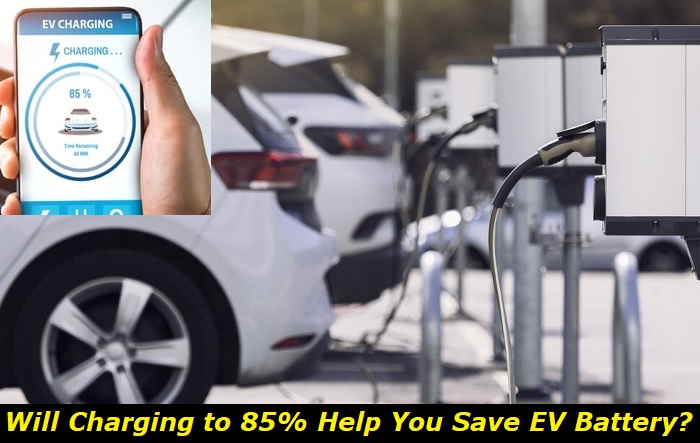
Although most of us can afford to charge EVs to 85% and care about batteries, we prefer having 100% charge and the maximum range. Let's see if the strategy of 85% charge really pays off and helps you save the battery for a longer time.
Let's get started!
Why is the 85% charging rule so popular?
This theory has been scientifically proven on mobile phones. With a charging of p to 85%, any Li-Ion battery showed more charging cycles and eventually longer life. But I couldn't find any large-scale research and so the idea still seems under-investigated.
This is a very long-lasting myth that was studied by many young researchers and they proved that the Li-Ion battery that is charged to 85% regularly can go through significantly more charges. For example, it can save over 95% of its life for 1500 charges while if you charge it to 100%, it will save only 80% of its life when charged 1500 times.
But, I don't know why, researchers forgot to tell you that when you charge the battery to 100%, you have more time (or better range when it comes to EVs). Let's say you have a battery for 50 kWh. If you charge it to 100%, you can use 50 kWh. But with 85% of the charge, you will only use 42.5 kWh of capacity. If you count 1500 charges, you will see that charging the battery up to 100% will give you an additional 11,250 kWh or eleven megawatts of power that you will use from the battery for this time.
So, the theory is very controversial and I can't rely on the studies that have been conducted.
What do EV owners say?
You may say, OK Dmitry, but there are thousands of electric vehicle owners in the US and you can ask them and find those ones who only charge their vehicles up to 85% and ask them how their batteries do. And I did this, but still, the results were confusing.
I figured out that the Nissan Leaf 1 has one of the poorest batteries among all popular EVs in America, so I spoke to dozens of Leaf owners all over the country and even beyond. I found so many people who charged their Leaf batteries strictly up to 85%! But the results on their battery life were very misleading.
While several owners said that they managed to keep the battery at 98% of life at 100,000 miles with this strategy, some others said that their batteries were replaced at 120,000 miles because of very poor range. Again, we don't have the answer here and I start understanding why.
Does it really help your EV battery when you charge it to 85%?
Yes, it helps the battery to save some life, but there are so many other factors that this method just can't show its efficiency. For example, this method can add 1% of preserved battery life for 4-5 years of use. It's so tiny that you will not even notice it.
But there are other factors that will kill your EV battery much faster than you think. And those factors are really important to know and understand.
Even though charging up to 85% really helps a little, I don't recommend bothering much. You really get a shorter range and have some inconveniences because of this, but you only get a very little advantage in the battery life. This gain just isn't worth all the discomfort that you will have to deal with.
But what else should and shouldn't you do to save the EV's battery life?
Factors that kill your EV battery even if you charge it strictly to 85%
1. Deep discharge
If the battery in an electric vehicle is fully discharged, it loses its life pretty fast. Although many cars are equipped with special control modules that don't allow the battery to discharge to zero percent, you will still damage the battery if your dash shows less than 10% or 5% of charge.
The rule of thumb is to let the EV discharge to 20% of its capacity and then charge it. If there is less than 20% of juice on your EV battery, it has already started deteriorating faster than you think.
2. Storing in cold weather
It's always a good idea to provide your EV with a garage that has a controlled climate. Or maybe you should think of storing it in a parking lot that is heated. In winter, your EV battery has a hard life and will discharge much faster than you think. Also, the battery loses its life in cold weather.
Driving your EV in winter is OK. Leaving it for 3-4 hours in an open parking lot near your office is also OK. But leaving it for a night near your house is not something the battery will thank you for. Cold weather catalyzes the loss of battery life.
3. Power-wasting driving style
Using AC, turning on all lights, listening to loud music, charging your phone in your EV - these are all habits that are taking charge of your battery faster than if you just drive. Electric vehicles need new driving habits that are concentrated on battery life.
The best strategy to prolong the lifespan of the battery in your EV is to spare its charge and charge it as rarely as possible. The charging cycles are the worst enemies of battery life, so the more you charge the EV battery, the sooner it dies.
4. Sitting for more than two weeks
If you are buying an EV, you should understand that driving it is like walking your dog. You should drive it regularly, otherwise, the battery will degrade much faster. I know a person who owns quite an old Tesla Model S with over 500,000 miles on it. And the battery is still the one that he bought it with. Although it's almost dead, it can still give him about 150 miles of range. And he doesn't do anything special - just takes his Tesla for a ride every day earning money with a taxi app.
So, don't let your EV sit for more than a week or two weeks. If you do this, don't forget to charge the EV sometimes to let the battery always stay over 20%.
5. Use "ECO" modes
This is another question about driving habits. If you like abusing your EV, the battery will not live long. Once it starts losing its charge quickly, the battery starts degrading. If you are driving carefully and follow those economy instructions and tips that pop up on your dash sometimes, this will let you use the battery much longer and have more advantages from owning an EV.
But if you abuse the car, want fast acceleration, and drive at high speed for a long time, the EV battery will deteriorate quite fast and will make you invest money in its replacement. And this is not cheap at all.
How long will an average EV battery live?
If you make some efforts to prolong the life of the battery in your electric vehicle, it will live much more than you think. On average, such batteries can survive for 10 years and beyond covering more than 200,000 miles for this time.
But if you neglect all the guidelines and tips about how to preserve the lifespan of an EV battery, you are likely to lose your expensive battery after 3-5 years and only 100,000 miles. The difference is huge, so it's really worth your effort.
The lifespan of an EV battery depends on many things:
- its initial capacity - the more, the better;
- your driving style and habits;
- the way you store your car, especially in winter;
- your charging habits;
- the number of charging cycles;
- the type of battery;
- the way of charging - superchargers kill the battery faster.
I can add some other factors but they will not be so crucial. When your EV battery has less than 80% of life in it, it's time to think about any possible repairs.
How can you repair the battery and avoid replacement?
You may know that replacing your EV battery is pretty tough for your budget. The average modern battery can cost up to $10,000 and even more, in some cases. So, you may try and repair the battery by replacing only sections and segments in it.
For this, you will need to find a shop that can diagnose your battery, check its life, and offer the best way to restore the unit. Many EV batteries consist of separate sections that can be changed or added to get your EV back on the road.
So, you should do something to prolong the life of your battery in the electric vehicle. But charging it up to 85% is not the best way to save the battery from being degraded. There are other things you should know and do.
About the authors
The CarAraC research team is composed of seasoned auto mechanics and automotive industry professionals, including individuals with advanced degrees and certifications in their field. Our team members boast prestigious credentials, reflecting their extensive knowledge and skills. These qualifications include: IMI: Institute of the Motor Industry, ASE-Certified Master Automobile Technicians; Coventry University, Graduate of MA in Automotive Journalism; Politecnico di Torino, Italy, MS Automotive Engineering; Ss. Cyril and Methodius University in Skopje, Mechanical University in Skopje; TOC Automotive College; DHA Suffa University, Department of Mechanical Engineering





Add comment