




The fuel in your car can't reach the engine without the fuel pump. And the pump behaves in certain ways to perform this role optimally and safely, depending on the scenario. Therefore, it's only right that you know how it works so that you can notice abnormalities easily.
A car's fuel pump should only run for 2-3 seconds when you switch on the ignition while the engine isn't running. It should only stay on if the engine is cranked and left to keep running. This is the normal way for the fuel pumps of fuel-injected vehicles to operate.
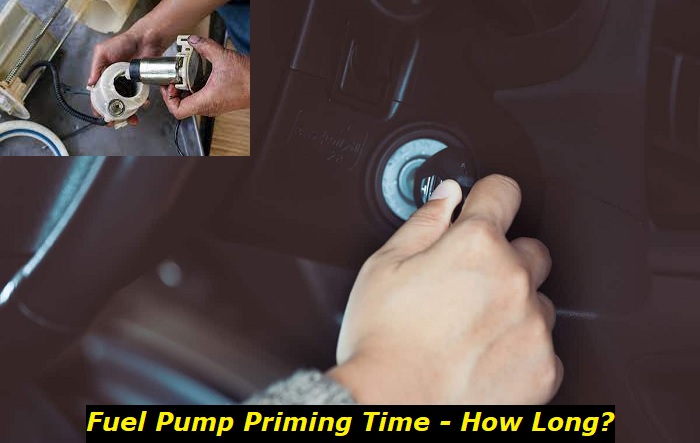
Fuel pump priming is a role played by the pump to make sure that pressurized fuel is available in the engine injector inlet when needed. We'll elaborate on this function in subsequent subheadings. It's obviously related to the main question of this guide.
Why Fuel Pump Priming Is Necessary
The fuel supply hose behind the injection system is normally filled with pressurized fuel. This is to facilitate the immediate firing of the engine cylinders.
However, the fuel deposit in the supply hose or carburetor may not have adequate pressure. It may even be dried up. There won't be sufficient pressurized fuel in the cylinder because of this.
The above situation means that a combustion cycle won't take place when you switch the ignition on and the spark plug fires. You'd have to crank the engine to fill the supply hose or carburetor with pressurized fuel.
Users of old vehicles would have to step on the gas pedal multiple times until the car comes alive. This is to prime the fuel pump in the case of an in-line fuel pump. Some vehicle fuel pumps feature manual primers that could be a lever or plunger which has to be worked for priming to take place.
Recent-year model cars that possess FI fuel injection systems have fuel tanks that feature in-tank electric pumps. This pump type comes with a self-priming functionality. And it allows the pump to run for 2-3 seconds once the ignition is set to "on" before you crank the engine.
Typical Fuel Pump Priming Sequence
Your car's ECU (electronic control unit) or ECM (electronic control module) enables the fuel pump relay for a few seconds. The relay will in turn come on to supply current to the pump so that the pump can build pressure in the supply hose.
The crank position sensor will send an alert to the ECU/ECM that the engine wasn't cranked if you don't start the engine (turn the key) within 3 seconds. It will lead to the ECU disabling the pump relay, thereby stopping the pump from running.
Don't forget that the pump forces the air trapped inside itself into the fuel tank during priming. The pushing out of the air is done via a vapor jet hole on the pump's inlet plate.
The crank position sensor will transmit a message to the ECU to switch the pump on when the engine begins to run. This is a preset sequence that is coded in the ECU. It makes sure that the pump runs and keeps the supply hose under the right pressure.
Fuel atomization will be possible in the next stage now that the hose is prepared for fuel injection before the engine cranks. Proper combustion will follow.
When the Fuel Pump Keeps Running Unnecessarily
Your car can't move without your fuel pump working, so it would be annoying to find out that it's misbehaving. Thankfully, it's easy to notice that the pump is defective since it's related to many driving problems.
The fuel pump is bound to misbehave sometimes. It may keep priming and not close off even with the ignition set at "on" after the pre-defined timing. Your battery will get drained if this is allowed to continue.
What you should do in this situation is remove one of the battery terminals to close off the pump. Battery power will be saved this way, especially overnight.
The fuel pump gets its power from the battery. That's part of the reason your car's alternator needs to keep the battery recharged. There'll be a problem when you make a mistake like leaving your headlights on overnight. Your battery charge will be drained and may not be able to power the pump.
It's also bad for your fuel pump to run continuously/unnecessarily because of faster wear and tear on the fuel system's parts. The pump won't be spared from this. But this will only happen if you keep running the vehicle with the ignition on regularly.
Hard starting during the winter is another problem that can result from the pump running incessantly. Cold weather can bring about electrical issues in a vehicle, particularly when it's not in use. The fuel system's electrical connections aren't an exception.
A battery that's drained will stress the fuel pump more when you try to start the car during winter. The pump will wear faster because of the push to apply extra effort in performing its role.
Causes of a Fuel Pump Running with the Ignition On
It's best to deal with the problem of the pump as fast as possible. Utilize various troubleshooting steps to find out the cause. One or more of the following might be the cause of your fuel pump running continuously with the key on:
1) Inaccurate Fuel Gauge Reading
This can cause the pump to run or cease to run abnormally. And it should be resolved ASAP. The issue may be with the sending unit which can be situated at any of the following locations to measure fuel levels:
- Gas tank
- Fuel pump assembly (attached or as a stand-alone unit)
2) Faulty ECU/ECM
The ECM is supposed to cut off the pump's power after 3 seconds of initial priming. So you'll know that there's a problem with it when this role isn't being carried out. It may be that the ECU's driver is shorted. You may possibly see signs of burns or moisture.
Swap out the unit if you can confirm that it's defective or unusable. You can troubleshoot by substituting your ECU with one from a different vehicle of the same model and year. It could be that of a friend or family member.
3) Stuck/Defective Fuel Pump Relay
The relay may send power to the pump continuously when it's faulty, stuck, or closed. And that's even when the ignition is set to "on" only. Mechanics may fix this issue by shorting the relay with the installation of a jumper wire or fuse between the load-side relay blades.
4) Bad/Incorrect Cable Connections
Check for faulty or wrong wire connections. For example; the cable that runs from the ECM to the fuel pump relay. It may be damaged or corroded. It may also be exposed and in contact with the vehicle's frame, resulting in the permanent grounding of the relay.
Bad wiring can keep the relay on constantly. This will supply the fuel pump with a regular current of 12 volts when the ignition is on. Thus the pump won't close off.
Another example of a wrong connection could be the technician's mistake during diagnostic testing. He or she may plug the pump's wiring directly into the 12-volt supply, thereby bypassing the relay.
Check the airflow sensor connectors and the cold start injector connectors to see if they were wrongly swapped. They can be confused with one another. You'd face difficulty in starting your car and also notice the fuel pump running non-stop.
5) Bad Crankshaft/Camshaft Position Sensor
The crankshaft and camshaft position sensors are among the most relevant sensors in a vehicle. They're essential to ignition timing and the distributor's functionality.
A crankshaft sensor tracks crankshaft rotation to determine piston location. It sets ignition timing, supplies the RPM (revolutions per minute) signal, and ascertains engine speed.
On the other hand, a camshaft sensor tracks camshaft rotation to determine valve position in the combustion process. It confirms which cylinder is firing to initiate injector synchronization and coil firing pattern in a DIS (distributorless ignition system).
An ECU could get an RPM signal from a defective crank sensor even when the engine isn't running. This will trigger the ECU to enable power for the fuel pump. The latter will therefore run non-stop.
Other possible causes of the fuel pump running while the key is at the "on" position are listed below.
- Bad oil pressure switch
- Shorting of the ignition switch
- Faulty MAF (mass airflow sensor)
What To Do When Running the Key While the Engine is Off?
You can set your ignition at the accessory position if you want to run the key when the engine isn't running. For example; you may want to listen to the car's radio for a long time frame.
Conclusion
You should play your part when you notice that something is off with the pump by quickly conducting a diagnosis with a scan tool. This is because the issue might have ripple effects on other areas of the fuel system. It may ultimately hurt your driving experience.
About the authors
The CarAraC research team is composed of seasoned auto mechanics and automotive industry professionals, including individuals with advanced degrees and certifications in their field. Our team members boast prestigious credentials, reflecting their extensive knowledge and skills. These qualifications include: IMI: Institute of the Motor Industry, ASE-Certified Master Automobile Technicians; Coventry University, Graduate of MA in Automotive Journalism; Politecnico di Torino, Italy, MS Automotive Engineering; Ss. Cyril and Methodius University in Skopje, Mechanical University in Skopje; TOC Automotive College; DHA Suffa University, Department of Mechanical Engineering





Add comment