




You can expect a lot of impressive features from the 2023 Nissan Rogue. One of these is the side sonar sensors that help drivers avoid accidents. These tiny pieces of tech are designed to detect objects in your blind spots. The sonar system is your eye in the back of your head. It will ensure you have a decent view of everything in your periphery and comes in very handy when negotiating in and out of parking spots.
If you are wondering where your sensors are located, how they work, and whether they are operating correctly, this article will answer all these questions. And a few more. We will also be highlighting the other pieces of tech hardware and software that work in tandem with your side sonar sensors to ensure you have the safest driving experience possible.
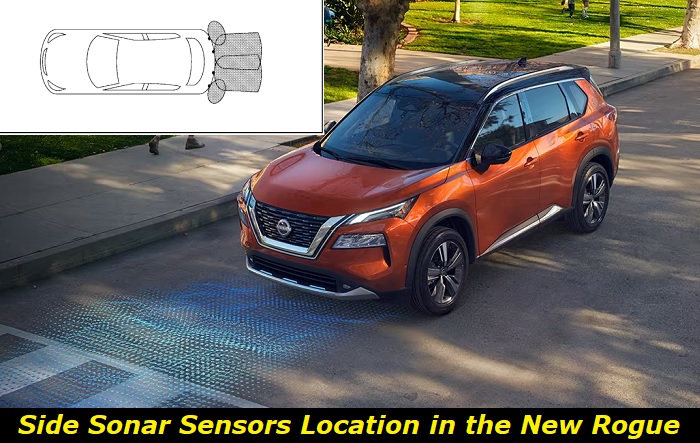
Where are the Side Sonar Sensors in Your 2023 Nissan Rogue Located?
The 2023 Nissan Rogue has twelve sonar sensors; four for the center, corner, and side. Your side sonar sensors are almost imperceptible unless you know where to look. They are designed to do their job without getting in the way.
Side sonar sensors are tucked into the sides of your front and rear bumpers with a pair at each end. Two pairs of corner sensors are found at the corners of the front and rear bumpers while two pairs of front sensors are at the center of the front and rear bumpers.
How Does Sonar Work?
Sonar is an acronym that means sound navigation and ranging. Humans ripped the mapping technology from animals like whales and bats and found all sorts of uses for it. A typical sonar system has a display, transmitter, transducer, and receiver.
The side sonar transmitters emit an impulse that is transmuted into a sound wave by the transducer. When the wave encounters an object it bounces back and the display system indicates where it is located.
Your side sonar sensors rely on their ability to emit and receive sound waves to help you navigate your environment with ease. This means that your sensors must remain unobstructed by dirt, ice, snow, or any other road debris.
Any obstructions or damage to the sensors may mute, absorb or redirect the transmitted soundwaves, thus preventing optimal functioning. Obstructions could also alter the mapping because of distorting the incoming sound wave.
How Does the Sonar System in Your 2023 Nissan Rogue Work?
Your sonar system applies the general principles described above to function. When the sonar system is activated, your vehicle information display will show you the sonar view. Should there be obstacles in your path, the sonar system will make a sound that alerts you of the danger. The sonar indicator uses different colors to show you how close the object is.
Your sonar system is not like the flight radar system on a fighter jet, there are plenty of things it may miss. Mostly because it is primarily designed to detect big stationary obstacles that may damage your vehicle. By no stretch of the imagination should you rely on your sonar system to help you evade moving or small objects. Some of the items your sonar system may have trouble detecting include wedge shape objects, thin obstructions e.g. wire, chain, or rope, and fluffy objects like cotton, cloth, snow, or glass wool.
Nissan is quick to warn drivers that though efficient, the sonar system is not a substitute for parking skills. Like most pieces of technology, it performs best when handled by a skilled and diligent person. Ultimately it is your responsibility to scan your surroundings and determine that it is safe to park or pull out of a parking spot. It is also recommended to understand how your sonar system operates and its limitations to use it safely.
By the way, recently I posted the article telling you about the front radar sensor problem and error message in Nissan cars - you may be interested in reading this, too.
Limitations of Your 2023 Nissan Rogue Sonar System
Certain conditions may cause your sonar system to underperform or malfunction. You are well advised to avoid over-relying on your sonar system under any of the following circumstances:
- Detecting thin, fluffy, or wedge-shaped objects as mentioned in the section above.
- Detecting small or moving objects
- Detecting small objects under the bumper or those that are very close to the sides or bumpers.
- Detecting pedestrians, especially small children, or animals.
- Very cold or wet weather conditions - the build-up of ice and snow around your bumpers will interfere with the transmission and reception of sound waves.
- Ultrasonic disruptions from machinery like compressed air brakes and pneumatic drills that distort soundwaves are also known to affect the performance of the sonar system or cause false activation. Even the blaring horns from other drivers may interfere with your sonar detection system, which is why you must not rely on it entirely.
- Opening windows or playing loud music may cause you to miss the sound that alerts you when an obstacle is detected.
- Your bumpers have suffered some damage that has caused them to be bent or misaligned. Such dimension alterations will affect the sensing zone and cause false alarms due to inaccurate measurement of obstacle distance.
- When your bumper or area around the sensors is exposed to extreme heat or cold.
Nissan also warns that the sonar system on your 2023 Rogue could trigger false alarms in the following scenarios:
- Overgrown grass around the car
- An object like a tunnel, wall, or toll booth on your vehicle's side
- Objects on the road surface e.g. bumps, manhole covers, or other protrusions
- Driving through a curtain or a draped flag
- Driving on steep terrain
- Accumulation of ice or snow around the car
How Your Side Sensors Work With Rear and Centre Sensors
All your sensors work together to map the area around your car and offer audible and visual warnings of any potential obstacles. You will only be warned about side obstacles after receiving the front, rear, and corner sensors. The front, corner, and rear corners come first because they potentially cause more damage to your car.
After the alert has been raised, your 2023 Nissan Rogue will predict an obstacle path to help you evade side obstacles. It is important to note that the sensor system deactivates once the speedometer goes 6mph, and kicks in once you slow down.
When the sensor system detects an obstacle, a blinking green indicator will appear as an intermittent tone plays. As your car gets closer to the obstruction, the blinking indicator will turn yellow and increase its blink rate. If you get any closer to the object the indicator will turn solid red and no longer blink. The warning tone on the other will stop being intermittent and sound continuously.
How to Enable and Disable Your Nissan Rogue's Sonar System
Your sonar system should power up automatically any time your ignition switch is on and your shift lever is in the drive or reverse position. If you want to fine-tune your sonar system settings, follow these steps:
1) Use your scroll dial to pull up the settings menu on your display.
2) Select Driver Assistance and then Park Assist
3) Your scroll dial should now allow you to navigate the sonar system menu and change various settings including:
- Moving object which turns the Moving Object Detection on or off.
- Auto show sonar mode which allows the system to take over your display whenever you start your car.
- Front sonar turns the front sonar sensors on or off.
- Rear sonar turns the rear sonar sensors on or off.
- Side sonar turns the side sonar sensors on or off.
- Sonar distance alters your sonar systems detection distance to short, medium, or long.
- Sonar volume adjusts the volume of the warning tone from low to medium or high.
What to Do When Sonar System is Temporarily Unavailable
Your 2023 Nissan Rogue will deactivate the sonar system should it detect any blockage. Your sonar system will not come back online until you remove the blockage. Your sensors may be blocked by temporary conditions like fog, mist, or splashing water. At times the blockage may be due to frost, ice, or dirt getting stuck on your bumper and obstructing your sensors.
How to Maintain Your Sonar System
Maintaining your sonar system is tied to caring for your front and rear bumpers. Nissan recommends the following tips to ensure your sonar system working efficiently:
- Cleaning the bumpers with a soft cloth whenever they get dirty.
- If your bumper suffers damage that causes it to become bent or deformed, it is best to have repaired by a certified Nissan dealership.
- Do not paint over the sensor area or use bumper stickers that cover the region. Limiting your sensor's range could cause a malfunction.
- Ensure that high-pressure car wash machines are not directed at your sensors.
- Do not alter your vehicle's height or use tires and wheels that differ in size from the OEM.
Conclusion
Side sonar sensors work with center and corner sensors to improve your parking experience. If you suspect your side sonar is malfunctioning, seek the assistance of the licensed dealership for effective and durable repairs. In the meantime, you could switch off the side sensors if they keep throwing false alarms.
About the authors
The CarAraC research team is composed of seasoned auto mechanics and automotive industry professionals, including individuals with advanced degrees and certifications in their field. Our team members boast prestigious credentials, reflecting their extensive knowledge and skills. These qualifications include: IMI: Institute of the Motor Industry, ASE-Certified Master Automobile Technicians; Coventry University, Graduate of MA in Automotive Journalism; Politecnico di Torino, Italy, MS Automotive Engineering; Ss. Cyril and Methodius University in Skopje, Mechanical University in Skopje; TOC Automotive College; DHA Suffa University, Department of Mechanical Engineering





Add comment